
Last updated: November 2026.
Let’s get this out of the way. Dubrovnik is on this list, and yes, every summer it’s an absolute shit show. Cruise ships unload thousands of people at once and the Stradun turns into a slow-moving human traffic jam, but I still love the place.
If Dubrovnik is the only thing you see on the Dalmatian coast of Croatia, you basically flew halfway around the world to eat the free bread and leave before your main showed up. Dalmatia has 79 islands and more than 500 islets. Walled towns. Roman ruins people still live in, with their laundry hanging off 1,700-year-old walls. Oysters pulled out of the water that morning. Wine that’ll put you flat on your ass. Water so stupidly clear you’ll swear someone photoshopped it.
These are the ten places we loved most on the Dalmatian coast, ordered south to north from Dubrovnik to Split so you can travel them as a route.
This site contains affiliate links to products and services. We may receive a commission for purchases made through these links which help keep us on the road and cost you absolutely nothing.
Table of Contents
Dubrovnik

Dubrovnik sits at the bottom of the Dalmatian coast, and for most people it’s where the trip starts. Referred to as the Pearl of the Adriatic, Dubrovnik has all of the charm and popularity one could want, and the HBO hit show Game of Thrones made it even more popular. Is it over touristed? Absolutely! Between the cruise ships and the tour groups the old town can feel like a theme park in July and August. But don’t let that stop you from visiting. Come in the shoulder season, or get out early before the cruise ship crowds roll off the boats.
Two to four days is the sweet spot. It’s long enough to walk the medieval walls and eat well, and short enough that you’re gone before the cruise crowds wear you down. Explore Dubrovnik’s Old Town early and late, once the day-trippers have cleared out, and save the middle of the day for the sea. Most of the old town runs on laminated menus and tourist pricing, but a handful of restaurants in Dubrovnik are cooking proper Croatian food that’s worth every euro.

When you’re done, you’ve got two ways north. In season, passenger catamarans run up the coast to Korčula, Hvar, Brač and Split, so you can island-hop without a car. If you’re driving, you no longer have to cross into Bosnia at Neum, and Ston is about an hour up the road.

Lokrum
If the crowds in Dubrovnik become a bit much, and they will, hop on a boat to Lokrum. It’s a short ride from the old harbour, and a lot of people who spend days in Dubrovnik have no idea it’s even there. When we got off the boat with about 200 other people, we started to doubt the whole quiet island thing, but the paths split off so fast that within ten minutes we pretty much had the place to ourselves. Well, except for the eleventy billion peacocks.

Legend has it the Benedictine monks who were kicked off the island cursed anyone who tried to live there after them. Their old monastery now houses an Iron Throne replica if you need your cheesy tourist photo. Angela left her purse sitting next to it with all of our money and credit cards inside, and it was still there when we ran back for it, so maybe the curse only applies to residents.

If you have the legs for it, make the hike up to Fort Royal. The path is steep and slippery, especially in the cheap sandals we thought were a good idea, but the view back over Dubrovnik and the Adriatic is worth every drop of sweat. Then reward yourself with a swim off the rocks.
Ston & Mali Ston
An hour north of Dubrovnik, the crowds fall off a cliff. Ston and Mali Ston sit at the neck of the Pelješac peninsula, two tiny towns stitched together by a medieval wall that climbs straight up and over the hill between them. Most people blow right past Ston and Mali Ston on their way to somewhere else, and that’s their loss.
Come for the walls, but stay for the oysters. Mali Ston has been farming them in the bay for centuries, and slurping a dozen right next to the water they came out of, with a cold glass of local white, will ruin every other oyster you’ve ever eaten.

From here, the Pelješac peninsula runs west toward Korčula, with vineyards lining the road almost the whole way. This is Plavac Mali country, the big, dry red that Dalmatia does best, so take the slow road out to Orebić, stop at a winery or two, and catch the ferry to Korčula from there.

Korčula
We spent three months living on Korčula, and if I’m honest, it’s not an island with tons to do. That’s kind of the point. The longer you stay, the more it gets under your skin.
Most visitors only ever see the east end. Korčula Town looks like a mini Dubrovnik from the water, a walled old town on its own little peninsula, but inside it’s a fraction of the size and a fraction of the crowds. The streets are laid out like a fish skeleton, angled to catch the summer breeze and block the winter wind. Locals will tell you, with a completely straight face, that Marco Polo was born here. Grab a sunset drink up on the old walls, catch a Moreška sword dance if you’re here in summer, and when you need a beach day, head to Lumbarda. It has sandy beaches, which are rare in Dalmatia, and Grk, a white wine from vines so weird they can’t even pollinate themselves.

Then drive west. The road runs through the middle of the island, past the vineyards where Pošip comes from, all the way to Vela Luka at the other end. This is where Angela’s family is from, and it couldn’t be more different from Korčula Town. It’s a working fishing town at the end of a deep bay, with no walls, no cruise crowds and barely a souvenir shop. Hike up to Vela Spila above town, a cave people were living in more than 20,000 years ago, then come back down for grilled fish on the waterfront. When it’s time to move on, there’s no need to backtrack, because the catamaran from Vela Luka runs straight to Hvar and Split.

Where to Stay on the Dalmatian Coast

Dubrovnik: – The Pucić Palace – A restored baroque palace in the middle of the old town, a few steps off the Stradun. It’s the splurge pick, but walking out your door before the cruise crowds show up is worth every euro.

Hvar: – Riva Hvar Yacht Harbour Hotel – Right on the harbour in Hvar Town, so the yachts are basically parked outside your window. The main square, the old town and the hike up to the fortress are all a short walk away.

Split: – Plaza Marchi Old Town – A boutique stay inside Split’s old town, a short walk from Diocletian’s Palace and the Riva. It’s an easy base for exploring on foot, and close to the port when it’s time to head out to the islands.
Looking for other great places to stay on the Dalmatian Coast? Use the search bar below to find more options
Proizd
We’re cheating a little bit with this one because Proizd is technically a part of Korčula, but it doesn’t feel like it. Proizd is as close to heaven on earth as you can get. If beaches, islands and a bit of nature are your thing, this is the place for you. We can’t get enough of it. Proizd ranks at the very top of the most beautiful water we’ve seen anywhere in the world, and I lived in the Bahamas for 20 years. The sea is so clear with a stunning variety of shades of blue and green, it’s truly a sight to behold.
Proizd is a small and uninhabited island just off the west coast of Korčula, so it’s a quiet place. Nature trails, one small restaurant and several beaches are the only things on this island, so it’s perfect if you’re looking for some peace and quiet. You’ll need to catch a ferry from nearby Vela Luka to get here. And watch out for the cliffs. I was so taken by the view that I flew my drone straight into one of them. This was our number one spot in all of Dalmatia, and nothing has changed our minds.

Vis and the Blue Cave
Vis sits farther out to sea than almost any other inhabited Croatian island, and for decades nobody could visit. The Yugoslav army used it as a naval base, and it stayed closed to foreigners until 1989. That’s a big part of why Vis still feels less touristy than its neighbours.
The headline act is the Blue Cave on Biševo, a small island just off Vis. Sunlight comes in through an opening under the water and lights the cave up electric blue. We nearly skipped this trip, and we’d have been idiots. Tickets work on a numbered queue and ours was about 300 people back, so our captain took us to Medvidina Cave while we waited. You can swim 160 metres into the rock, until it’s too dark to see your hand.

On Vis itself, Stiniva beach is reachable only by boat or a steep footpath, through a gap in the cliffs just a few metres wide. Finish in Komiža, a fishing town whose fishermen emigrated to Washington State and helped build the Pacific salmon industry. We had salted anchovies and sardines and a spiced Adriatic tuna steak at Dal Mare on the waterfront, and it was the right call. We did it as a day trip by boat from Vela Luka, but tours also run from Split and Hvar.

Hvar Town
Hvar Town has a reputation as the party capital of the Adriatic, and it earns it every summer. Yachts stacked three deep in the harbour, beach clubs pumping until sunrise, and a whole lot of sunburned twenty-somethings trying to remember where they left their shoes. At our age that’s just not our scene anymore, but if you write Hvar off as nothing but a party town, you miss most of it.
Get up early, before the night crowd has even rolled over, and you’ll have the old stone alleys, the waterfront and the main square almost to yourself. It’s one of the prettiest towns on the coast, and the hike up to the fortress above town gives you one of the best views in Dalmatia. Just don’t do it in the midday heat like we did.
The catamaran from Vela Luka drops you right on the Hvar Town waterfront, and when you’ve had enough of the yachts, Stari Grad is a short bus ride across the island.

Stari Grad
While Hvar Town didn’t exactly vibe with us, Stari Grad on the same island most definitely did. It’s a short bus ride across the island, and the atmosphere is a complete 180. No yachts stacked in the harbour, no beach clubs, just a sleepy waterfront and a town that’s been going about its business for a very long time. The ancient Greeks founded it as Pharos in 384 BC, which makes it one of the oldest towns in Europe, and the farmland behind it, the Stari Grad Plain, is a UNESCO World Heritage Site still farmed the same way it was 2,400 years ago.
Wander the waterfront and the back streets, walk Middle Street, the old main street where Roman mosaics more than 2,000 years old have been uncovered, and if you like hiking uphill more than we do, take a beer up Glavica hill for sunset. We also ate some of our best meals on Hvar here: homemade pasta (and a rakija or three) at Jurin Podrum, falafel and pulled duck tacos at Nook, and strawberry cheesecake ice cream from Jagoda on the Riva to cool off.
From here, Brač is just across the channel. In season, a catamaran runs from Jelsa, a short bus ride down the road from Stari Grad, straight to Bol. Book it early and have a backup plan, because we learned that one the hard way.

Wondering What to do on the Dalmatian Coast? Have a Look at Some of These Tours From Viator:
Bol and Zlatni Rat
Getting to Bol nearly broke us. Our ferry from Hvar got cancelled, then the replacement we booked with another company got cancelled too, 16 hours before departure. We ended up going the long way round through Split, five hours of waiting included. Was it worth the hassle? Absolutely.
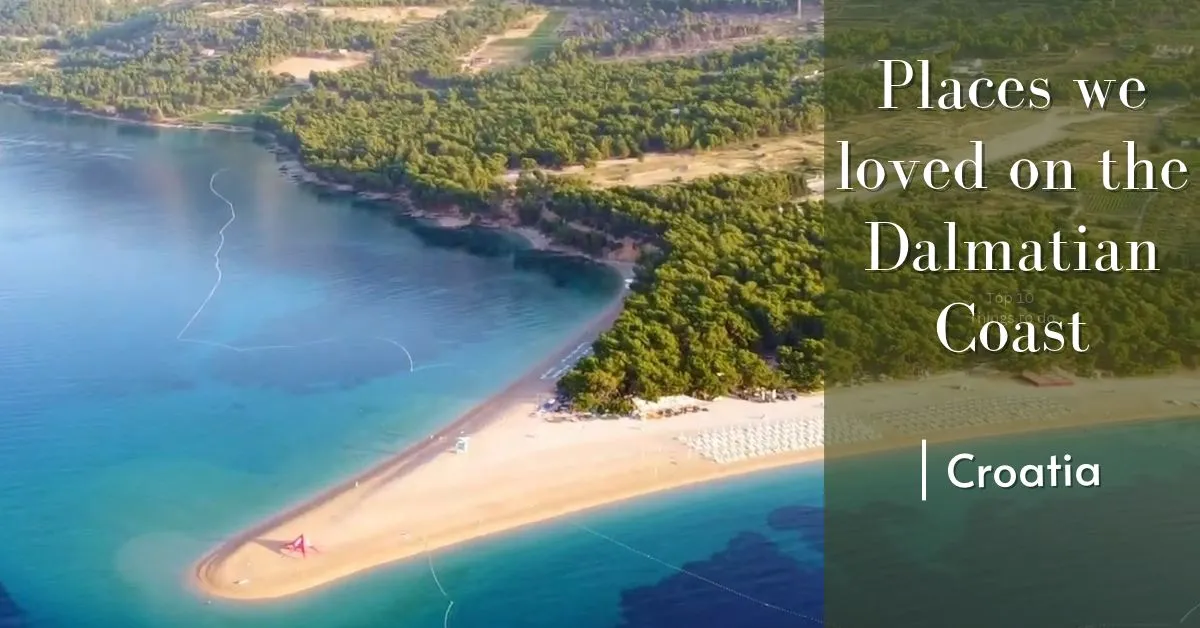
Zlatni Rat is the reason you come. Every picture you’ve seen of it is probably a drone shot, a long spit of beach sticking out into the sea and shifting with the wind and the currents. It isn’t white sand like it looks in those photos, it’s millions of tiny smooth white pebbles. Walk out along the waterfront from town first thing in the morning and you’ll have the whole thing to yourself. Come back at noon and it’s wall to wall people.
The actual town of Bol doesn’t have a ton to do. It’s a small town, a lot like many of the little towns on the Dalmatian islands, but that’s fine because you’re here for the water. Stina Winery on the waterfront is an amazing spot to enjoy the local wine and watch the sunset over the harbour. And if you’re really feeling up for it, you can hike up Vidova Gora behind the town. It’s the highest peak on any of the Adriatic islands and the views are supposed to be incredible. We didn’t do it. It was way too hot and we’re way too lazy.

Split
Split is where this route ends, and it’s one of my favourite cities in the world, so I’ve saved the best for last. People live, work and drink every night inside a Roman emperor’s retirement palace, and after a couple of weeks of sleepy island towns, the noise and energy hit you all at once in the best way.
Once you’ve had your fill of the old town, get out of it. Walk west and up the steps onto Marjan, the forested hill that takes up the whole end of the peninsula, for views back over the city and the islands you’ve just come from, with a few quiet swimming coves on the far side. Or go east to Bačvice, Split’s sandy city beach, and watch the locals play picigin, a game where they keep a tiny ball in the air while diving around knee-deep water like lunatics. In the evening, skip the touristy cocktails and dig into the city’s craft beer scene. When you’re hungry, finding a meal that isn’t a tourist trap takes some work, so eat like a local and you’ll do just fine.
Split is also the transport hub of the whole coast. The airport is only 30 minutes away, Trogir is an easy half-day trip, and catamarans and ferries run out to almost every island on this list if you want to do the route in reverse.

If you would like to help support Pure Detour you can do so at: Buy Me A Coffee
Final Thoughts
So that’s our list. Ten places on the Dalmatian Coast that we would go back to in a heartbeat, from the walls of Dubrovnik all the way up to Split. Pick a few, take your time between the islands, and don’t trust a ferry schedule until you’re actually standing on the boat.
Have you been to the Dalmatian Coast? Did we leave your favourite off the list? Leave a comment and let us know, and help other travellers experience the beauty of Dalmatia!
FAQ
How many days do you need on the Dalmatian Coast?
As many as you can get. We’ve been numerous times and have spent months in the country and still haven’t seen everything.
If you want Dubrovnik, Split and two or three islands without running yourself into the ground, plan on at least 10 to 14 days. A week will get you Dubrovnik and Split with a couple of day trips. Ferries run on fixed schedules, so island hopping always takes longer than you think.
When is the best time to visit the Dalmatian Coast?
May, early June and September. The water is warm enough to swim, the ferries are running full schedules and you’re not fighting the cruise ship crowds for every square metre of the old towns.
Half of June and then July and August are hot, packed and expensive. From November to March a lot of the island restaurants and hotels shut down for the winter and the ferry schedules can be non-existent.
How do you get between the Dalmatian islands?
Ferries and catamarans. Jadrolinija runs the most routes, and smaller companies like TP Line and Krilo fill in the gaps.
Car ferries are slow but take vehicles, while catamarans are faster and for foot passengers only. Book ahead in summer and always have a backup plan. We had two ferries cancelled on us just trying to get from Hvar to Bol.
Should you stay in Split or Dubrovnik?
For island hopping, Split wins. It has the most ferry and catamaran connections out to Hvar, Brač, Vis and Korčula.
Dubrovnik works better for a shorter trip built around the old town, Lokrum, Ston and day trips over to Montenegro. A lot of people fly into one and out of the other and work their way along the coast in between, which is exactly what we’d do.
Do you need a car on the Dalmatian Coast?
No. Buses connect the coastal towns, and the ferries and catamarans take care of the islands, so you can do the whole coast without ever getting behind the wheel.
A car does help on the bigger islands like Brač, Hvar and Korčula where buses don’t run often, and for the wineries on Pelješac. Just know that taking a car on the ferry costs extra and needs booking in summer.
Can you visit the Blue Cave from Split?
Yes. Speedboat day tours to the Blue Cave leave from Split and Hvar, and most of them add Vis, Stiniva and a few swimming stops. We did ours by boat from Vela Luka on Korčula.
The cave closes when the sea is rough, so don’t leave it until your last day. Tickets are handed out by number at the dock, so expect to wait in summer.